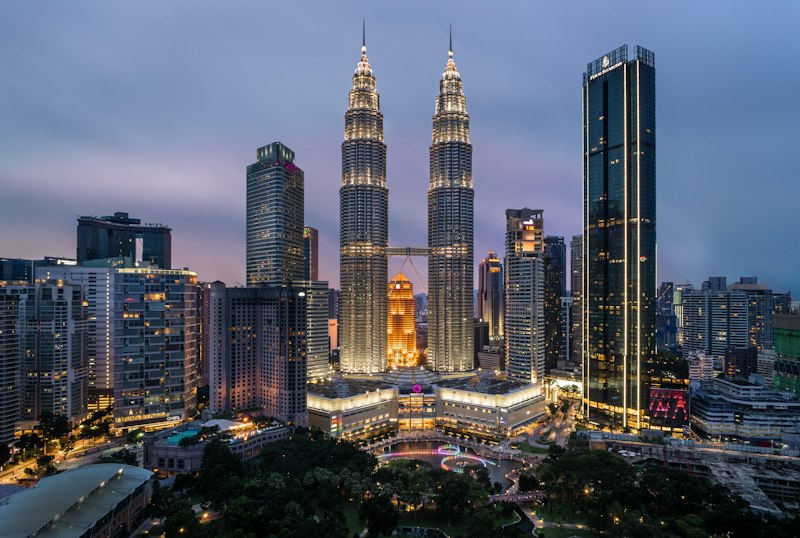
Kuala Lumpur is one of Southeast Asia's best-value capital cities and, for budget travelers, one of its most strategic. As the home hub of AirAsia, it has some of the cheapest flight connections in the region, making it a natural starting point or layover for a wider trip. But KL is far more than a transit stop. It's a fast, modern, multicultural metropolis where gleaming skyscrapers rise over century-old shophouses, and where some of the best food in Asia is sold from hawker stalls for a couple of dollars.
What makes KL special is the blend. Malay, Chinese, and Indian cultures live side by side, which means your day can move from a Hindu temple at Batu Caves to a Chinese night market on Petaling Street to a plate of nasi lemak at a Malay warung. The skyline-defining Petronas Twin Towers anchor a city that is genuinely easy to navigate: English is widely spoken, the rail network is clean and cheap, and a huge share of the best sights are completely free. It's also a comfortable place to land first in Southeast Asia, with international standards and low prices.
This guide covers everything you need to do Kuala Lumpur on a budget: how to fly in cheaply, the best-value neighborhoods to stay in, the free and low-cost things to do, how to use the city's excellent public transport, realistic daily budgets for every travel style, and the practical tips that save money and hassle, including the new digital arrival card every visitor now needs.
Getting There: Flights
Kuala Lumpur is served by Kuala Lumpur International Airport (KUL), which has two terminals: KLIA (Terminal 1) for full-service carriers and KLIA2 (Terminal 2), the dedicated low-cost terminal and AirAsia's main base. A smaller airport, Subang (SZB), handles some regional turboprop flights on Firefly. Because AirAsia is headquartered here, KL has an unusually dense, cheap network across the region.
Here are the cheapest corridors for flying into KL:
Singapore to Kuala Lumpur — From around $30-60 one way on AirAsia, Scoot, or Jetstar. One of the busiest short routes in the world. If fares spike, the intercity bus or train via Johor Bahru is a cheap alternative.
Penang to Kuala Lumpur — From around $20-40 one way (a quick domestic hop on AirAsia or Firefly), among the cheapest flights you'll find anywhere.
Bangkok to Kuala Lumpur — From around $50-80 one way on AirAsia. Multiple daily flights to both KL terminals; book 2-3 weeks ahead and fly mid-week for the best fares.
Jakarta to Kuala Lumpur — From around $50-70 one way on AirAsia or Batik Air, with frequent departures.
Bali (Denpasar) to Kuala Lumpur — From around $70-130 one way on AirAsia, with the lowest fares typically in the May and September shoulder season.
Pro tip: most budget carriers use KLIA2, which connects to the city by the same KLIA Ekspres train and airport buses as Terminal 1. Travel light: AirAsia strictly enforces its 7kg carry-on limit, and pre-booked checked bags are far cheaper than paying at the airport.
Where to Stay
KL has excellent budget accommodation, and the best value is concentrated in a few well-connected neighborhoods.
Chinatown / Petaling Street — The best budget base. Central, walkable, packed with hostels, and a short walk or LRT ride from KL Sentral and the colonial core. Dorm beds from $7-11 (RM30-50), private rooms from $20-35.
Bukit Bintang — The shopping and nightlife heart, right next to the Jalan Alor food street. Slightly pricier but full of social hostels and superb transport links (Monorail and MRT). Dorms from $8-12, private rooms from $25-45.
KL Sentral / Brickfields (Little India) — Ideal if you value transit convenience, as every rail line meets at KL Sentral and the airport train terminates here. Good mid-range value and great Indian food.
Chow Kit — A more local, no-frills area just north of the center with some of the cheapest rooms in the city.
Booking tip: Hostelworld usually has the best prices and reviews for dorms, while Booking.com is stronger for private rooms and budget hotels. Book a few weeks ahead during major events and the Hari Raya / Chinese New Year periods, when the city fills up.
Search accommodation in Kuala Lumpur
Things to Do
A remarkable number of KL's highlights are free or nearly free:
Free activities:
- Explore KLCC Park beneath the Petronas Twin Towers, and catch the free Lake Symphony fountain show in the evenings
- Climb the 272 rainbow-painted steps at Batu Caves (free entry), past the giant golden Murugan statue
- Wander the colonial core around Merdeka Square and the Sultan Abdul Samad Building
- Browse Central Market and the buzzing Petaling Street (Chinatown) night market
- Visit the hilltop Thean Hou Temple for free city views
Budget activities:
- Petronas Twin Towers observation deck and skybridge: around $22 (RM98) for non-Malaysian adults — the one splurge worth booking online in advance, as daily tickets sell out
- KL Tower (Menara KL) or the newer 'The View at 118' at Merdeka 118 (now the world's second-tallest building): roughly $12-25 for sky-high views
- Perdana Botanical Gardens (free) and the adjacent KL Bird Park (about $16)
- Eat your way down Jalan Alor food street after dark for a few dollars
Day trips: Genting Highlands (cool mountain air and a cable car), Putrajaya's modern architecture, and the historic, UNESCO-listed city of Melaka (about 2 hours by bus). For organized tours and skip-the-line tickets, GetYourGuide has the widest selection with free cancellation on most bookings.
Book activities in Kuala Lumpur
GetYourGuideGetting Around
Getting around KL is cheap and easy once you understand the rail network:
Trains (MRT, LRT, Monorail, KTM Komuter) — The integrated rail system reaches almost everywhere a traveler needs to go. Fares run about $0.25-1.20 (RM1-5) per trip. Tap in with a Touch 'n Go card or a contactless bank card — no paper ticket needed.
Free GOKL City Bus — Four color-coded loops circle the central districts (Bukit Bintang, KLCC, Chinatown, Merdeka) completely free. Slow in traffic, but unbeatable value.
Grab (ride-hailing) — The easiest door-to-door option. A typical cross-city ride is about $3-7, always cheaper and less hassle than flagging an unmetered taxi (which you should avoid).
Batu Caves — Take the KTM Komuter train directly from KL Sentral for about $0.60 (RM2.60) each way.
Airport transfers:
- KLIA Ekspres train: the fastest option at 28 minutes to KL Sentral, about $9 (RM40), with ~10% off when booked on the official app or website
- Airport coach bus: the cheapest option at about $3-4 (RM12-15) to KL Sentral, taking roughly an hour
- Grab: around $15-20 depending on traffic
Budget Breakdown
Here's what a realistic daily budget looks like in Kuala Lumpur:
Backpacker budget: $30-45/day
- Dorm bed: $8-11
- Hawker and mamak food (3 meals): $8-12
- Transport (rail + free GOKL bus): $2-4
- One or two free/cheap activities: $5-10
- Drinks/snacks: $3-5
Mid-range budget: $60-90/day
- Private room or smart hostel: $25-40
- Mix of hawker food and casual restaurants: $15-25
- Transport (rail + occasional Grab): $5-10
- A couple of paid attractions: $10-20
Comfortable budget: $100-150/day
- Mid-range hotel: $50-80
- Restaurants and cafes: $25-40
- Transport (mostly Grab): $10-15
- Premium attractions and a day trip: $20-30
KL's single biggest budget advantage is food: a plate of nasi lemak, char kway teow, or roti canai from a hawker stall or 24-hour mamak costs just $1-3 and is often better than anything in a tourist restaurant. Note that alcohol is taxed and relatively pricey, so factor that in if you plan to drink.
Essential Tips
Fill out the MDAC before you arrive (important): Malaysia now requires almost all foreign visitors to submit a free Malaysia Digital Arrival Card (MDAC) online within 3 days before arrival, even if you're entering visa-free. Use only the official immigration portal (imigresen-online.imi.gov.my). It is completely free — ignore copycat sites that charge a fee.
Visa: Most Western nationalities (US, UK, EU, Australia, and others) get 90 days visa-free, but you still must complete the MDAC.
Best time to visit: KL is hot and humid year-round. It's relatively drier from June to August, and wetter around March-April and October-November, though rain usually comes as short, heavy afternoon downpours. Pack light, breathable clothing and stay hydrated.
Money: The currency is the Malaysian Ringgit (RM). ATMs are everywhere (some charge a small fee). Contactless cards and Touch 'n Go are widely accepted, but carry cash for hawker stalls and markets.
SIM card: Pick up a tourist SIM from CelcomDigi, Maxis/Hotlink, or U Mobile at the airport for about $3-7 (RM10-30) with generous data.
Food and water: Mamak stalls are cheap, halal, and often open 24 hours. Tap water is best avoided — stick to bottled or filtered water.
Language: Bahasa Malaysia is the official language, but English is very widely spoken, which makes KL one of the easiest cities in the region to get around.
Frequently Asked Questions
Is Kuala Lumpur expensive for budget travelers?
Not at all. KL is one of the best-value capital cities in Southeast Asia. Hawker meals cost $1-3, public transport is cheap and efficient, and many of the top sights, including Batu Caves and KLCC Park, are free. A backpacker can comfortably travel on $30-45 a day.
Do I need to fill out the MDAC before arriving in Malaysia?
Yes. Malaysia requires almost all foreign visitors to submit a free Malaysia Digital Arrival Card (MDAC) online within 3 days before arrival, even those entering visa-free. Use only the official portal (imigresen-online.imi.gov.my) and beware of copycat websites that charge a fee for what is a free service.
What's the cheapest way to get from the airport to the city?
The cheapest option is the airport coach bus to KL Sentral for about $3-4 (RM12-15), which takes around an hour. The fastest is the KLIA Ekspres train at 28 minutes for about $9 (RM40), with a discount for booking online. Grab is also available for around $15-20.
Is Batu Caves worth visiting, and is it free?
Yes. Entry to the main temple cave is free, and the 272 rainbow-painted steps and giant golden Murugan statue are a highlight. Reach it in about 30 minutes on the KTM Komuter train directly from KL Sentral for around $0.60 (RM2.60). Go early to beat the heat and the crowds.
How many days do I need in Kuala Lumpur?
Two to three days is enough to see the Petronas Towers, explore Chinatown and the colonial core, eat your way through the hawker scene, and visit Batu Caves. Add an extra day if you want a day trip to Melaka, Genting Highlands, or Putrajaya.